Asked to prove the source of your crypto? Learn why exchanges request Source-of-Funds evidence, what documents matter, and how to build a clear fiat and on-chain transaction history.
Receiving a Source-of-Funds request from a cryptocurrency exchange can be unsettling, particularly when withdrawals or other account functions have already been restricted.
It does not necessarily mean that the exchange believes your crypto is illicit.
Crypto exchanges and other regulated service providers use risk-based compliance procedures to understand where customer funds originate. When a transaction, deposit pattern or account history requires additional review, the platform may ask for documents showing how the assets were acquired and how they reached the account.
For straightforward cases, that may involve a few bank and exchange records. For someone who bought crypto years ago, moved it between personal wallets, traded across several platforms or used multiple blockchains, proving the history can be much more complicated.
A strong crypto Source-of-Funds submission is therefore not simply a collection of screenshots. It should create a coherent, verifiable chain between the legitimate economic origin of the funds and the cryptocurrency currently under review.
Why did my exchange ask for source of funds?
Crypto exchanges operate within anti-money-laundering and counter-terrorist-financing frameworks that require risk-based customer and transaction monitoring.
The FATF guidance for virtual assets and virtual asset service providers forms part of the international framework influencing how virtual asset businesses assess these risks.
A Source-of-Funds review can be triggered for many reasons.
A large deposit may differ significantly from previous account activity. Funds may arrive from a personal wallet for which the exchange has no immediately visible acquisition history. Cryptocurrency may have passed through several wallets or services before reaching the platform. An account may also be selected for additional review under the exchange's internal compliance procedures.
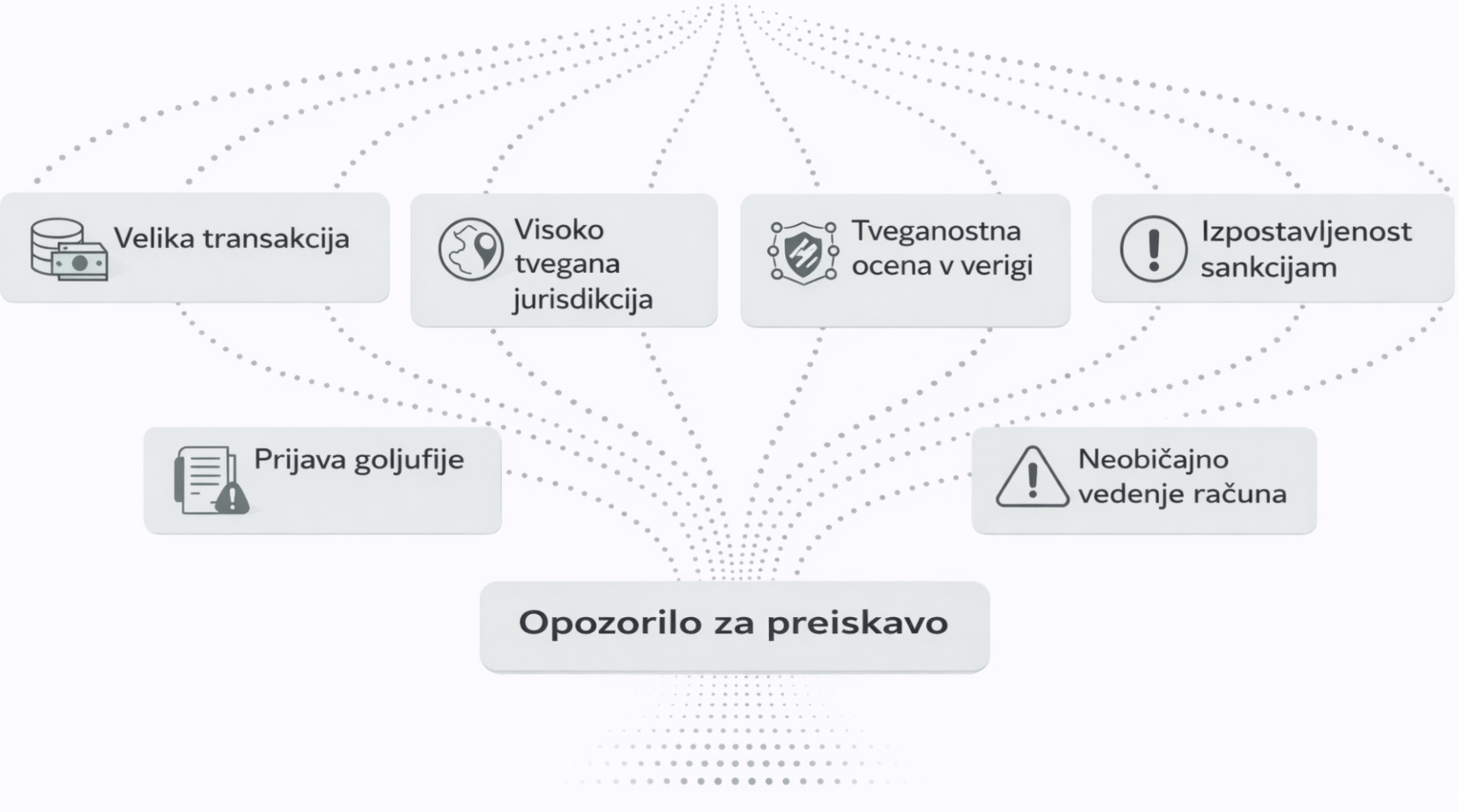
Depending on the platform's regulatory obligations, internal risk assessment and jurisdiction, certain account functions may be restricted while additional information is requested.
A Source-of-Funds request does not, by itself, establish wrongdoing. It means the institution needs additional evidence to understand whether the customer's explanation is consistent with the available account, financial and blockchain data.
What is source of funds in crypto?
Source of Funds refers to the origin of the specific money or assets involved in a transaction.
In a crypto context, the practical question is:
Where did this cryptocurrency actually come from?
The answer might begin with salary savings used to purchase Bitcoin through an exchange. It could involve business income, proceeds from selling property, investment proceeds, cryptocurrency purchased years earlier, inheritance, mining or another legitimate source.
The important point is that the explanation relates to the specific assets being reviewed.
Source of Funds is different from Source of Wealth.
Source of Funds focuses on the origin of particular assets or transactions.
Source of Wealth concerns how a person's overall financial position or wealth was accumulated.
Depending on the circumstances, an exchange, bank or other reviewing institution may ask for one or both.
For crypto assets, a proper Source-of-Funds history often needs to connect three distinct stages:
- Where the original economic value came from.
- How that value became cryptocurrency.
- How the cryptocurrency subsequently moved through wallets, exchanges or other platforms.
The challenge is usually not proving one isolated transaction. It is proving continuity between all three.
How do I prove source of funds for crypto?
The strongest approach is to build a continuous transaction history.
Start with the original economic source of the money.
For example, if Bitcoin was purchased using savings from employment income, supporting documentation may establish the legitimate origin of that fiat money and show the transfer to the exchange where the cryptocurrency was purchased.
Next, document the acquisition of the crypto.
Exchange statements, trading records, bank transactions and withdrawal records can help connect the fiat funds with the cryptocurrency that subsequently entered self-custody.
Then reconstruct what happened on-chain.
If the assets moved between personal wallets, those transfers should be mapped. If the crypto was later traded, sent to another exchange, bridged to another blockchain or converted into another asset, the relevant movements may also need to be explained.
Finally, the historical transaction chain needs to be reconciled with the assets currently under review.
Trading activity, partial disposals, fees and multiple transfers can make this more complicated than simply comparing the original purchase amount with the current balance.
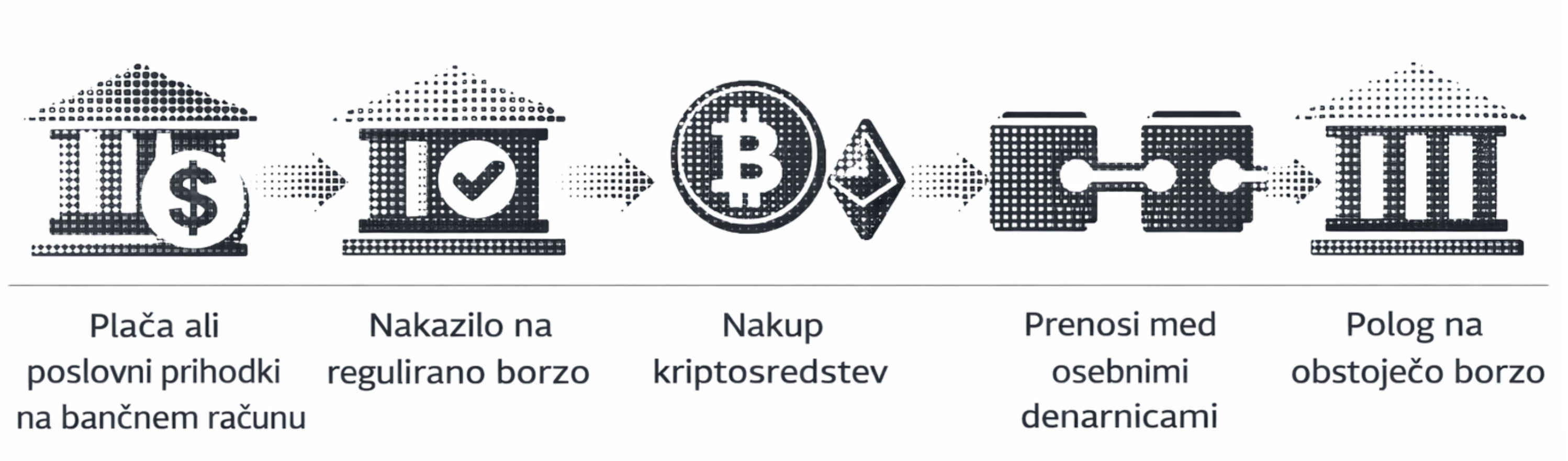
If any link in this chain is undocumented or lacks coherence when presented to the compliance team, verification may fail.
What documents do exchanges ask for?
There is no universal crypto Source-of-Funds checklist.
The evidence required depends on how the assets were originally obtained and what part of the transaction history the reviewing institution needs to verify.
Typical supporting evidence can include:
- Employment income or savings: bank statements, salary records and evidence of the original crypto purchase.
- Crypto purchased on another exchange: account statements, trading history, deposit records and withdrawal records.
- Sale of property, a company or another asset: sale agreements, settlement documents and corresponding bank transactions.
- Business income: invoices, contracts, company records, financial statements and bank records.
- Investment proceeds: brokerage or investment statements and subsequent bank or exchange transactions.
- Mining or staking: wallet records, platform documentation and transaction history showing the relevant rewards.
- Inheritance or gifts: documentation establishing the legal basis for the funds and their subsequent movement.
- Long-term crypto holdings: historical exchange records, transaction hashes and wallet history connecting the original acquisition with the assets currently being reviewed.
Screenshots can support a submission, but they should not replace independently verifiable records where those records are available.
The objective is not to submit as many documents as possible. It is to build a consistent evidentiary chain in which dates, amounts, wallets, exchange accounts and supporting records correspond with one another.
Can crypto source of funds be verified on-chain?
Blockchain analysis can verify an important part of a crypto Source-of-Funds history, but blockchain data cannot answer every question by itself.
A public blockchain can show that cryptocurrency moved from one address to another, when a transaction occurred, which assets were transferred and what happened to them subsequently.
In some cases, blockchain analytics can also identify interaction with a known exchange or other service.
What the blockchain usually cannot establish on its own is why a person originally acquired those assets, where the fiat capital came from, or who legally controls an unidentified self-custody wallet.
This is why proper Source-of-Funds verification combines on-chain and off-chain evidence.
Investigators can reconstruct blockchain transactions and compare them with exchange statements, bank transfers, purchase records, contracts and other supporting documents. The objective is to establish continuity between the claimed economic origin of the funds and the cryptocurrency currently under review.
Blockchain analytics tools can assist with transaction mapping, entity attribution and cross-chain reconstruction, but they are inputs to the investigation rather than proof on their own.
What does the source-of-funds verification process look like?
The exact process varies between institutions, but most cases follow a similar sequence.
Step 1: formal request
The exchange or other institution requests additional information about particular transactions, deposits, wallets or the overall origin of assets.
The request may specify which documents are required or identify particular activity that needs explanation.
Read the request carefully before preparing a response. A review concerning one transaction may require a very different evidence package from a review covering several years of account activity.
Step 2: evidence collection and reconstruction
The customer collects the relevant bank, exchange, wallet and supporting records.
Where the transaction history is complex, these records may also need to be reconciled with blockchain activity before submission.
The objective is to create one coherent chronology rather than a collection of disconnected documents.
Step 3: compliance review
The institution reviews the submitted explanation and supporting material against its own records, transaction monitoring data and risk assessment.
Additional questions may follow if there are unexplained transactions, missing records or inconsistencies between the explanation and the available data.
Step 4: decision
The institution determines whether the evidence sufficiently explains the origin of the assets under its compliance framework.
The result may be the removal of restrictions, a request for further information or another compliance decision.
There is no single universal timeline for Source-of-Funds reviews. Complexity, documentation quality, the institution's internal procedures and the need for additional verification can all affect how long the process takes.
What should a forensic source-of-funds report contain?
A forensic report should do more than list transaction hashes.
In straightforward cases, account statements and blockchain records may be sufficient to establish the relevant history.
More complex cases may involve several exchanges, personal wallets, token swaps, cross-chain transactions or years of trading activity. In those situations, the report needs to reconstruct the sequence in a form that a third party can understand and verify.
A structured Source-of-Funds report may include:
- identification of relevant wallets and exchange accounts
- chronological transaction history
- transaction hashes and blockchain references
- source and destination analysis
- wallet and entity attribution where supported by evidence
- cross-chain reconstruction where relevant
- comparison between blockchain activity and exchange records
- comparison with bank or other financial records
- explanation of significant transfers or changes in asset form
- supporting documentation and annexes
Professional blockchain analytics platforms can assist with entity attribution, transaction graphing, cross-chain tracing and risk screening.
However, access to sophisticated software does not automatically produce a defensible Source-of-Funds conclusion.
An investigator still needs to determine which transactions are relevant, assess the reliability of attribution, reconcile on-chain activity with off-chain documentation and clearly distinguish verified findings from assumptions.
Bloctopus Intelligence provides crypto Source-of-Funds verification for cases where transaction histories require this type of forensic reconstruction.
What makes source-of-funds cases difficult?
The most complicated cases are not necessarily those involving suspicious activity.
Often, they are simply poorly documented.
Someone may have purchased cryptocurrency several years ago, transferred it between personal wallets, moved to a different exchange, converted between assets and forgotten which wallet was associated with which account.
Years later, the assets may also be worth substantially more than the original purchase.
The blockchain transactions still exist, but the supporting documentation may be scattered across different platforms and financial institutions.
Other complications include:
- closed exchange accounts
- missing historical trading records
- transfers between personal wallets that were never documented
- decentralized exchange transactions
- cross-chain activity
- assets received from third parties
- incomplete bank records
- discrepancies between wallet balances and historical transaction records
These situations require reconstruction rather than explanation from memory.
Professional blockchain forensics can help map the on-chain transaction history and identify which pieces of off-chain evidence are still required.
The objective is not to create a convenient narrative. It is to produce a history that can be independently reconciled with the available evidence.
Common source-of-funds documentation mistakes
One of the most common mistakes is documenting only one side of the transaction history.
A bank statement showing legitimate income does not automatically establish that cryptocurrency deposited several years later came from that income.
Equally, showing that crypto arrived from a particular wallet does not explain how the assets in that wallet were originally acquired.
The two sides need to connect.
Another common problem is submitting screenshots without underlying transaction records or identifiers.
Unexplained wallet transfers, inconsistent dates and amounts that do not reconcile with the blockchain history can create additional compliance questions.
Customers should also avoid guessing.
If an old transaction cannot immediately be explained, it is better to reconstruct the history from verifiable records than to submit an explanation that later conflicts with blockchain data.
Sending large quantities of unrelated documents can also make the review harder rather than easier.
The goal is clarity.
A compliance reviewer should be able to follow the economic origin of the funds, their conversion into cryptocurrency and their subsequent movement without reconstructing the entire case independently.
What should you do if an exchange has frozen withdrawals?
If an exchange has restricted withdrawals and requested Source-of-Funds evidence, begin by identifying exactly what the compliance team wants explained.
Preserve the original request, all subsequent correspondence and copies of every document submitted.
Use only the exchange's official communication channels. Never provide a seed phrase, private key or wallet credentials to anyone claiming they can verify the funds or unlock the account.
Before submitting evidence, create a chronology connecting:
- the original economic source of the funds
- the acquisition of the cryptocurrency
- subsequent wallet or exchange movements
- the assets currently under review
Avoid repeatedly submitting the same incomplete material.
If the exchange identifies a gap, address that specific issue with evidence rather than adding unrelated documents.
Where significant assets, multiple blockchains or several years of transaction history are involved, professional forensic reconstruction can help convert fragmented records into a structured transaction history.
Legal counsel may also be appropriate where an account restriction develops into a legal dispute or where jurisdiction-specific procedures need to be assessed.
Building a source-of-funds file that can be urnderstood
A strong Source-of-Funds submission should answer three questions clearly:
Where did the economic value originate?
How did that value become cryptocurrency?
How did the cryptocurrency move from acquisition to the assets currently under review?
For simple cases, a small number of documents may be enough.
For complex histories involving multiple exchanges, personal wallets, trading activity or several blockchains, forensic reconstruction may be required to establish a coherent transaction chain.
The objective is not to overwhelm the reviewing institution with information. It is to make the origin and movement of the funds understandable and independently verifiable.
Source-of-Funds verification is therefore best treated as an evidentiary exercise rather than a form-filling exercise. Clear documentation, consistent on-chain records and an honest explanation of any gaps provide the strongest basis for a compliance team to assess the assets on their actual merits.