Bitcoin leaves a trail, but not every trail leads to a name or recovery. Discover what investigators can uncover, where the limits begin, and what makes a trace actionable.

When Bitcoin is stolen, sent to a scammer, or moved without authorization, the first question is often immediate: is Bitcoin traceable, or has it disappeared into an anonymous network?
Bitcoin is not anonymous in the way cash can be. Its transaction history is recorded on a public blockchain that anyone can inspect. However, a visible transaction does not automatically reveal the person controlling an address, and a successful trace does not automatically produce a recovery.
This distinction matters for victims, businesses, lawyers, compliance teams, and law enforcement. A blockchain investigation can reconstruct where Bitcoin moved, identify relevant services, and preserve evidence. Whether that evidence leads to a freeze, disclosure, seizure, or return of assets depends on factors beyond the blockchain itself.
This article explains what investigators can see, what remains hidden, and what makes a Bitcoin investigation actionable.
Is Bitcoin traceable? The direct answer
Yes, Bitcoin is traceable at the transaction level.
The Bitcoin blockchain is a public, ordered, and timestamped ledger. Each confirmed transaction links previously received Bitcoin outputs to new outputs, creating a historical chain that can be followed from one transaction to another. The official Bitcoin developer documentation describes the blockchain as a public ledger containing an ordered record of transactions.
Bitcoin is therefore better described as pseudonymous, not fully anonymous. The blockchain displays addresses and transaction data rather than names, passport numbers, or company details.
The practical question is not only “is Bitcoin traceable?” It is whether the on-chain trail can be connected to reliable off-chain evidence, such as exchange records, communications, device data, invoices, or police reports.
A blockchain explorer can display a transaction. It does not by itself establish identity, intent, ownership, or legal entitlement.
What the Bitcoin blockchain records
A confirmed Bitcoin transaction normally exposes:
- the transaction identifier, commonly called a TXID
- the Bitcoin inputs being spent
- the new outputs created
- the amount assigned to each output
- the transaction fee
- the approximate confirmation time and block
- the later transaction in which an output is spent
Bitcoin uses unspent transaction outputs, known as UTXOs. Each input refers to an earlier output, and each new output remains unspent until it is used in another transaction. The Bitcoin transaction guide explains this structure in detail.
This allows investigators to reconstruct the movement of value through a sequence of transactions. They can observe when funds are combined, divided, moved repeatedly, or sent to an address associated with a known service.
The record is durable, but its interpretation requires care. The blockchain shows what happened technically. It does not automatically explain why it happened or who authorized it.
What investigators can see
Starting from a known TXID or wallet address, investigators may be able to:
- follow Bitcoin through successive wallets
- calculate how much relevant value moved along each path
- identify consolidation, splitting, or repeated transfer patterns
- distinguish spent and unspent outputs
- detect interaction with attributed exchanges or other services
- monitor addresses for later movement
- create fund-flow diagrams and evidence tables
Investigators may also use clustering techniques to assess whether several addresses are likely controlled by the same wallet or entity. Spending multiple inputs together can sometimes indicate common control, while change-address analysis may help identify value returned to the sender.
These are analytical inferences, not automatic facts. Wallet design, CoinJoin transactions, custodial services, and unusual transaction construction can weaken simplistic assumptions. Strong forensic work documents the methodology, confidence level, alternative explanations, and limitations.
This is why the answer to “is Bitcoin traceable?” cannot be reduced to drawing arrows between addresses. The evidential value lies in disciplined interpretation and corroboration.
What investigators cannot see from the blockchain alone
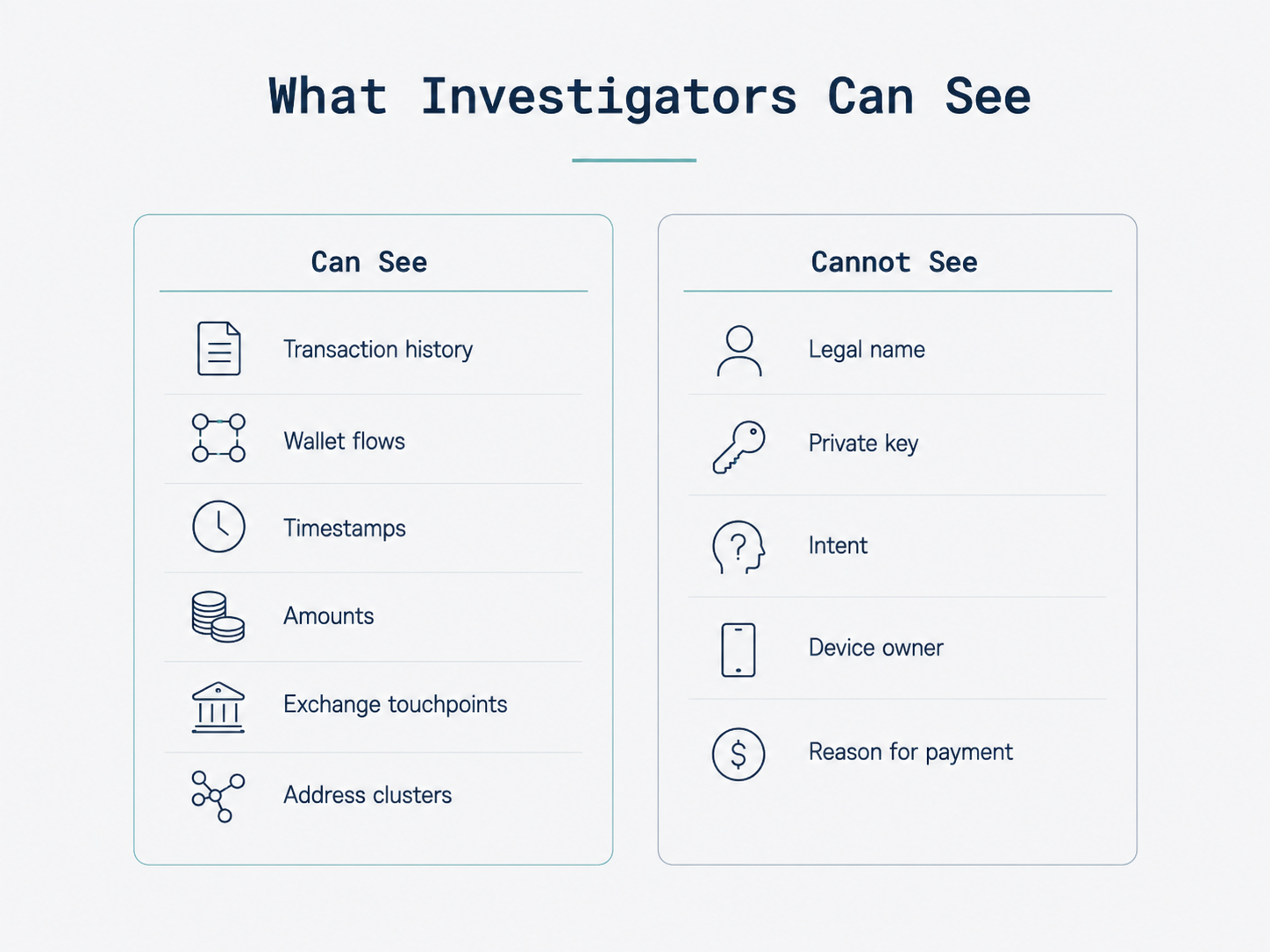
The Bitcoin blockchain does not directly reveal:
- the legal name of the person controlling an address
- contact details, an IP address, or the device used
- the private key or seed phrase
- the reason for a payment
- whether a transfer was lawful, fraudulent, mistaken, or coerced
- the beneficial owner of funds held by a custodian
- internal transfers recorded only inside an exchange database
An address is not the equivalent of a verified bank account. One person can control many addresses, several people can control one wallet, and an exchange can pool funds belonging to many customers.
Identity usually emerges when blockchain evidence reaches an attribution point. A regulated exchange may hold customer identification, login records, deposit data, and withdrawal history. Access to that information normally depends on platform procedures and an appropriate legal or law enforcement process.
Privacy techniques can complicate analysis. Address rotation, CoinJoin, mixers, long transaction chains, and conversion into other assets may reduce confidence or increase the work required. They do not erase the original Bitcoin record, but they can make attribution substantially harder.
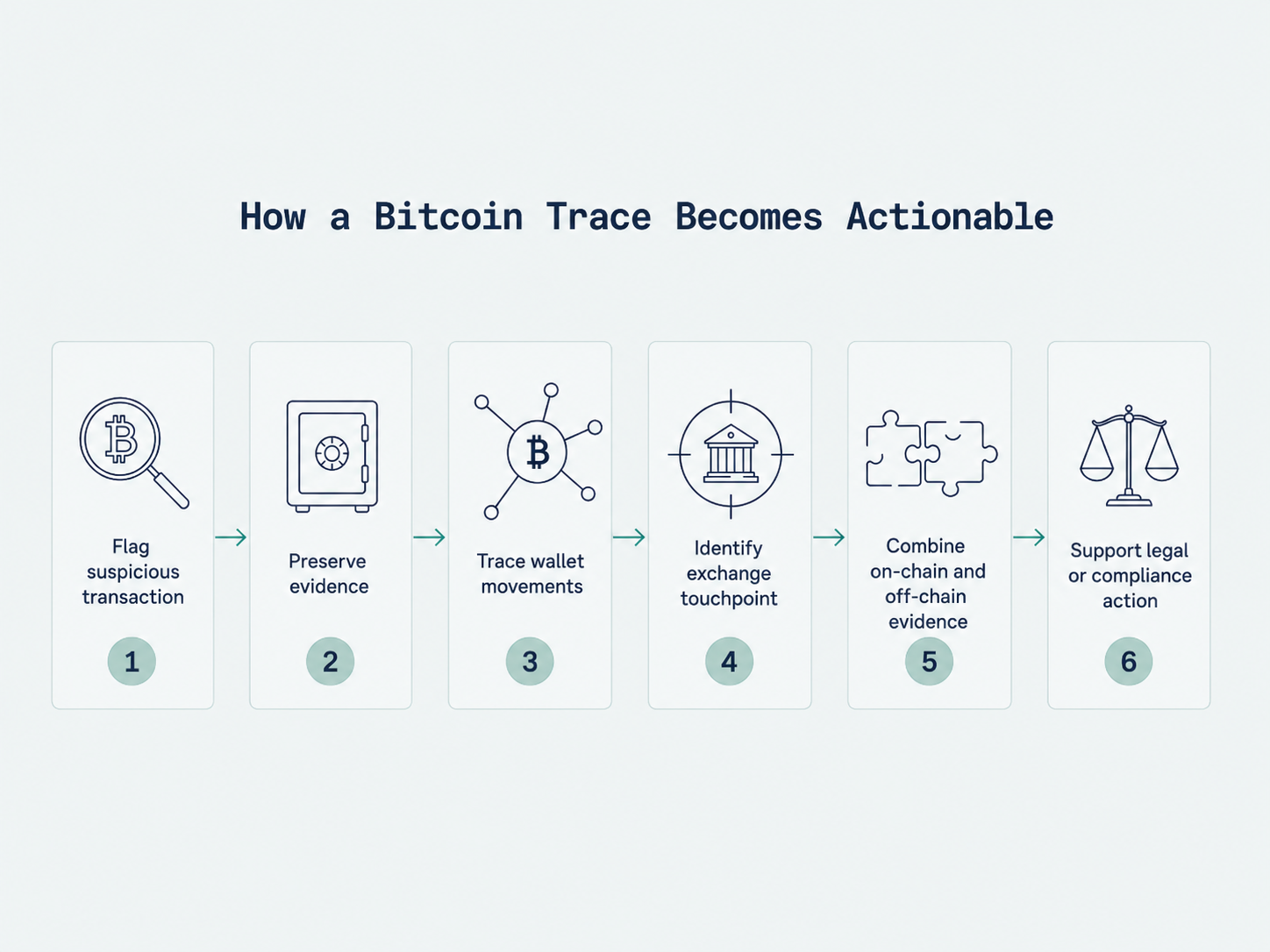
How Bitcoin tracing works in a real investigation
A professional investigation begins with verified starting evidence, such as a transaction hash, receiving address, exchange withdrawal record, or ransom address.
The investigator confirms the transaction and preserves the original data. The flow of funds is then mapped forward and, where necessary, backward. Each branch is assessed to determine whether the Bitcoin remains in self-hosted wallets, enters a service, is consolidated with other funds, or is converted through another platform.
On-chain findings are compared with emails, chat logs, exchange correspondence, internal records, device logs, and timestamps. A useful report clearly separates verified facts from analytical judgments.
The process may identify a practical intervention point, such as a centralized exchange with compliance controls. It may also show that the funds moved into an environment where legal reach, attribution, or cooperation is limited.
“The most important detail at the beginning of a Bitcoin trace is often the transaction outputs within the first few hops. They give investigators an initial indication of whether the funds were sent to a centralized service, a hosted wallet, or through a CoinJoin or mixing service. These early movements can also reveal behavioural patterns that help us understand how the person controlling the funds structures and conducts their transactions.” Žiga Karič, blockchain forensic investigator
Public authorities use this combined approach. In June 2025, the U.S. Department of Justice stated that blockchain analysis and other investigative techniques connected more than $225 million in cryptocurrency to investment-fraud laundering networks. This demonstrates what structured tracing can support, but not every case has comparable evidence or legal options.
Can stolen Bitcoin be traced or recovered?
Stolen Bitcoin can often be traced, but recovery is a separate question.
Tracing means reconstructing where the Bitcoin moved and documenting the evidence. Recovery requires an additional lawful mechanism to stop, seize, disclose, or return the assets. This may involve an exchange freeze, police investigation, court order, seizure warrant, civil proceedings, or another jurisdiction-specific process.
The strongest recovery opportunities often arise when traceable funds reach a cooperative centralized exchange or another identifiable virtual asset service provider. The platform may be able to preserve an account, review customer information, or respond to a lawful request.
Speed matters because funds can be moved, converted, withdrawn, or dispersed. Evidence quality matters because exchanges and authorities need more than an unsupported allegation. Jurisdiction matters because procedures and cooperation standards differ.
In one 2024 case, U.S. investigators traced part of a victim’s stolen Bitcoin after it had been converted to USDT, the issuer froze the relevant assets, and authorities later used a seizure warrant.
None of this creates a guarantee. Some Bitcoin can be traced but not recovered. Some trails become too uncertain, some services do not cooperate, and some funds move beyond a realistic enforcement route.
What makes a Bitcoin trace stronger or weaker?
A stronger investigation usually has a verified starting transaction, a clear timeline, complete exchange records, preserved communications, and early escalation. It becomes more useful when funds reach an identifiable service that maintains customer records and responds to lawful requests.
A weaker case may involve incomplete information, delayed reporting, multiple intermediary services, privacy-enhancing transactions, peer-to-peer cash-outs, or uncertainty about which transfer represents the loss.
Investigators must avoid overstating attribution. A transaction to a known exchange does not identify the customer on the public blockchain. A clustered wallet is not automatic proof of ownership. A suspicious pattern is not proof of criminal intent.
The Financial Action Task Force describes unusual transaction patterns, anonymity-enhancing technologies, and source-of-funds concerns as risk indicators. Indicators guide further investigation. They are not substitutes for evidence.
Bloctopus Intelligence applies this feasibility-first logic in its crypto funds tracking work, assessing not only where funds moved but whether the findings can support a realistic legal, compliance, or recovery step.
What to do after a suspicious Bitcoin transaction
Act quickly, but do not destroy evidence or expose yourself to a second scam.
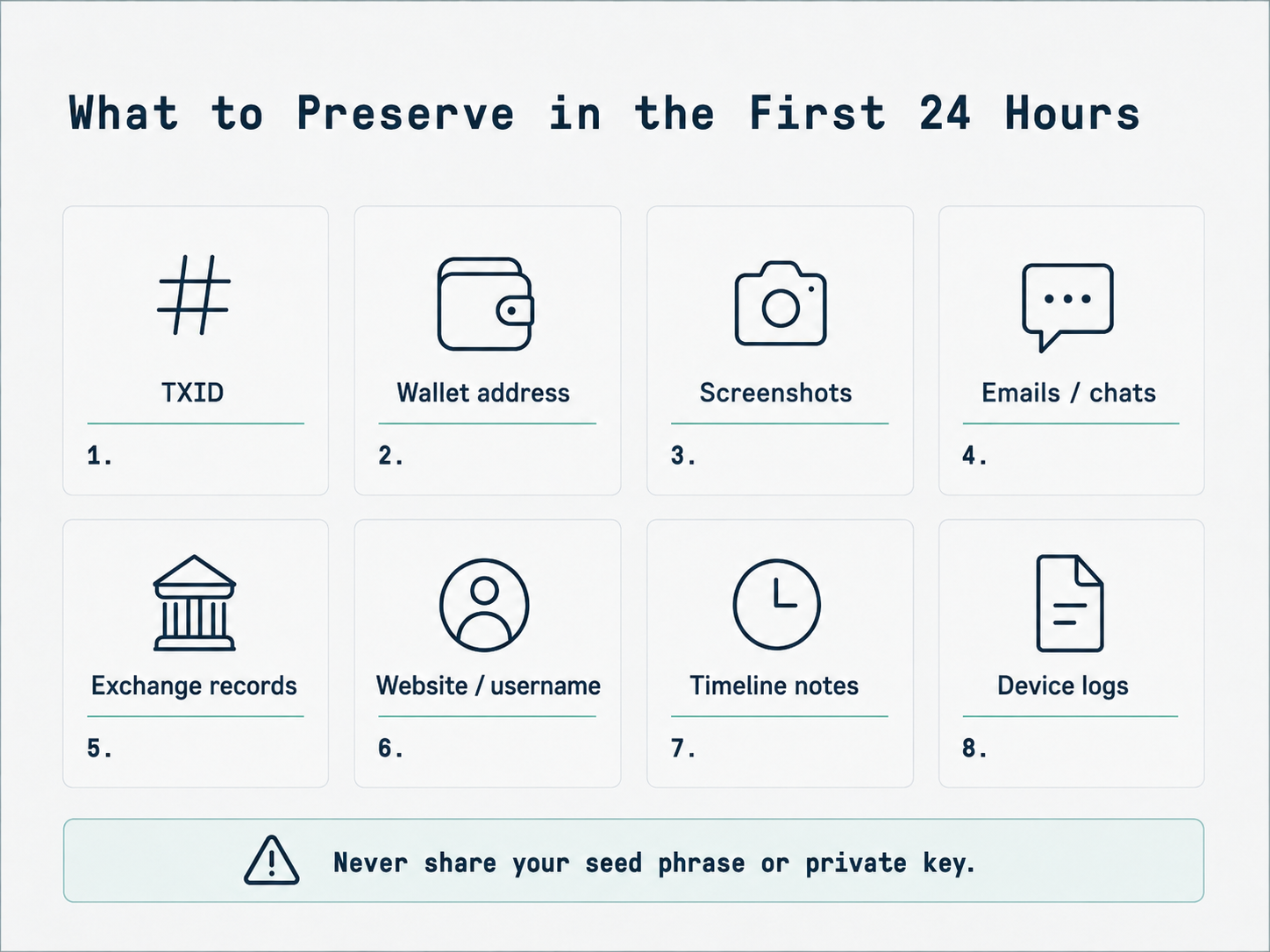
Preserve the TXID, wallet addresses, exchange statements, withdrawal confirmations, screenshots, emails, chat messages, website addresses, usernames, and a written timeline. Keep original files where possible.
Notify the exchange or wallet provider involved. If theft, fraud, extortion, or unauthorized access is suspected, report the incident to the appropriate law enforcement authority. Significant or complex cases may also require qualified legal counsel.
Do not share a seed phrase, private key, password, remote device access, or wallet control with anyone claiming to trace or recover Bitcoin. Legitimate investigators do not need those credentials to analyze public blockchain activity.
Be cautious of anyone promising guaranteed recovery, claiming to “hack back” the funds, or requesting more crypto for taxes, unlocking, verification, or release. These are common signs of a recovery scam.
Victims and businesses can seek a confidential feasibility review through Bloctopus Intelligence’s crypto scams and internal fraud service. The first objective should be to understand the evidence and realistic options, not to purchase a promise.
A public record, not a guaranteed outcome
So, is Bitcoin traceable? Yes, confirmed on-chain transactions are publicly recorded and can often be followed through a detailed transaction history.
What the blockchain does not automatically provide is the identity behind every address, the purpose of each payment, or the legal power to recover assets. Those conclusions require careful analysis, external evidence, platform cooperation, and an appropriate legal process.
A useful investigation preserves evidence, tests attribution, explains uncertainty, identifies intervention points, and assesses whether further action is proportionate and feasible.
For anyone facing theft, fraud, a disputed transfer, or hidden assets, the most reliable first step is an evidence-based assessment. Honest blockchain forensics should clarify what can be proven, what remains uncertain, and whether there is a realistic path forward.