A practical guide to reporting crypto fraud to exchanges, police and national cybercrime portals, with the transaction evidence that can make a complaint more actionable.

Quick answer: Report crypto fraud to the platform or exchange involved, your local police or national cybercrime authority, and the relevant official fraud-reporting portal for your jurisdiction. A good report should include transaction hashes, wallet addresses, amounts, dates, screenshots and communications. Reporting does not guarantee a refund, but it can create the record needed for coordinated investigation and exchange action.
Crypto fraud often crosses borders. The victim may live in one country, buy cryptocurrency through an exchange in another, send assets to wallets controlled elsewhere and communicate with scammers using infrastructure in several jurisdictions. That makes structured reporting especially important.
The purpose of a fraud report is not only to document that money was lost. A useful report gives authorities and platforms enough information to connect the incident with wallets, accounts, domains and other cases.
Who should you report a crypto scam to?
There is no single worldwide agency that handles every crypto fraud case. The right reporting path depends on where you live, how the fraud occurred and which platform or financial service was involved.
In most serious cases, think in layers rather than choosing only one recipient:
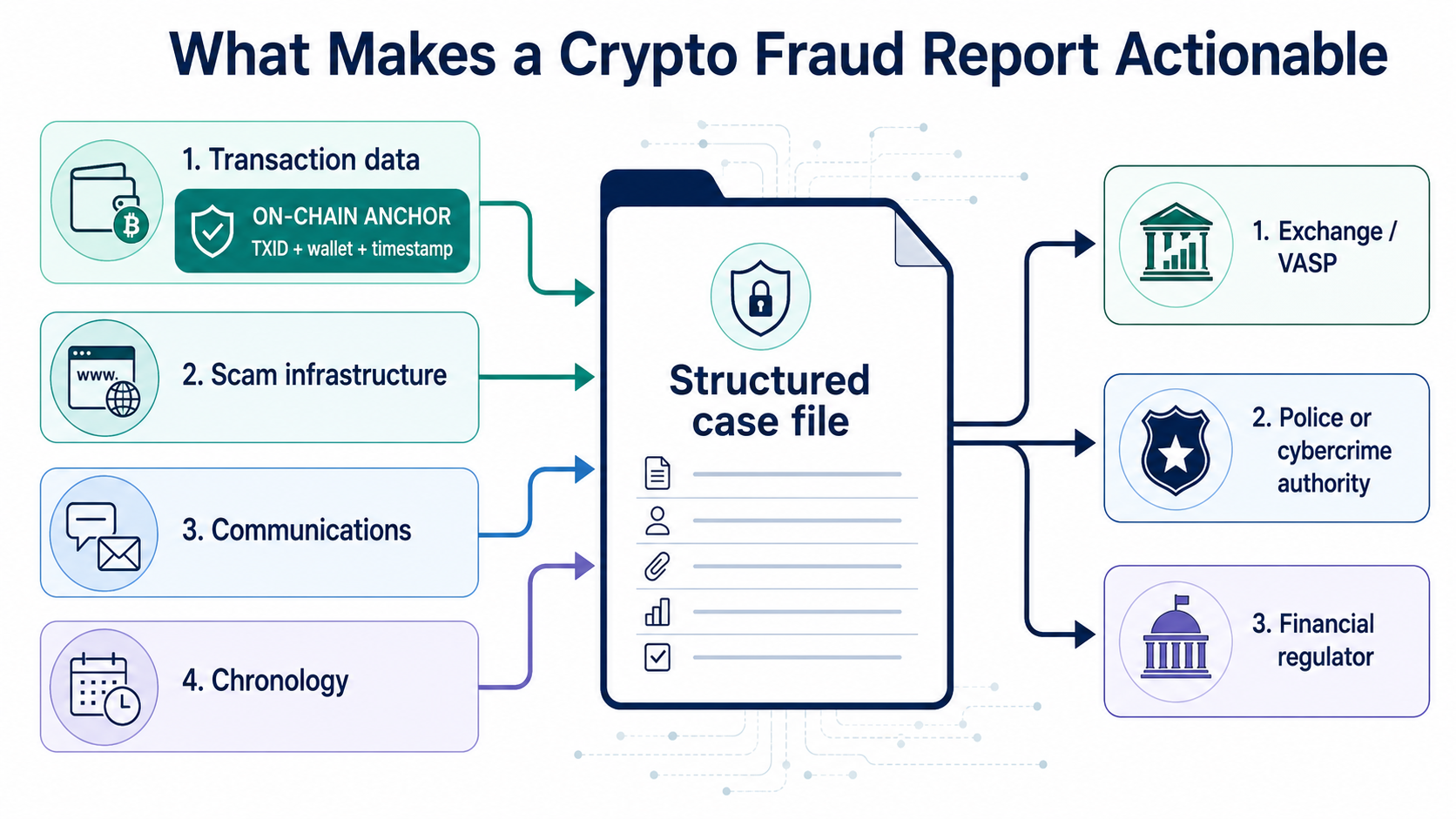
- The exchange or platform involved. Notify the service from which the assets were sent and, if tracing identifies another centralized exchange, the service that received them.
- Local police or the national cybercrime reporting channel. This creates an official crime report and may be needed for later requests to exchanges or courts.
- A national fraud-reporting portal. These systems aggregate intelligence and may connect your case with other victims or criminal infrastructure.
- A financial regulator when relevant. Investment fraud, unlicensed financial services or fraudulent trading platforms may also fall within a securities, commodities or financial regulator's remit.
Do not assume that reporting to a private wallet provider, social platform or exchange replaces a police report. Each organization has a different role.
Where can you report crypto fraud by jurisdiction?
Use official government or law-enforcement portals rather than links sent by someone who contacts you after the scam. Reporting mechanisms change, so verify the current process on the authority's own website.
European Union
Europol does not operate one universal victim complaint form for all EU cybercrime. Its Report Cybercrime Online directory routes victims to national reporting websites and advises victims to contact local police where a dedicated online option is not available.
United States
The FBI Internet Crime Complaint Center, IC3, accepts cryptocurrency-related complaints and provides guidance on the information victims should preserve. Fraud can also be reported to the Federal Trade Commission. Depending on the conduct, investment-related matters may also be relevant to the SEC or CFTC.
Australia
The Australian Government's ReportCyber portal is the national route for reporting cybercrime. The Australian Cyber Security Centre also directs scam victims to ReportCyber and to the National Anti-Scam Centre's Scamwatch where appropriate.
Canada
Victims can report fraud and cybercrime through the Canadian Anti-Fraud Centre. The CAFC also recommends that victims contact local police, explaining that its centralized reporting helps connect crimes and support investigations in Canada and abroad.
If you are outside these jurisdictions, start with your national police or cybercrime authority and the regulator responsible for the relevant financial activity.
Should you report to IC3 or local police?
In the United States, serious cases should not be treated as an either-or choice. IC3 is a centralized FBI reporting system that collects internet-crime complaints, while local police can create a local crime report and may be the first law-enforcement point of contact.
IC3 specifically asks cryptocurrency victims to preserve wallet addresses, transaction IDs or hashes and other technical information. That data can make the complaint more useful than a narrative that says only that cryptocurrency was stolen.
Where a large loss, active threat or time-sensitive exchange freeze is involved, legal counsel or direct law-enforcement engagement may also be appropriate. The correct route depends on jurisdiction and circumstances.
What information should a crypto fraud report include?
A well-documented report should make the incident understandable without requiring the reviewer to reconstruct it from scattered screenshots. Include, where available:
- Transaction evidence: transaction hashes, wallet addresses, blockchain, asset, amount and timestamps.
- Exchange information: account details, deposit and withdrawal history, support tickets and any account restriction notices.
- Scam infrastructure: website domains, app names, social-media profiles, email addresses, phone numbers and usernames.
- Communications: chat exports, emails, messages, payment instructions and promises made by the scammer.
- Financial records: bank transfers or legitimate exchange purchases used to acquire the cryptocurrency that was later sent.
- Chronology: when contact began, when deposits were made, when the scam became apparent and what happened after the victim attempted to withdraw or recover funds.
Preserve original files where possible. A transaction hash is more useful than only a screenshot because it can be checked independently against the blockchain.
The most common weakness in victim reports is not necessarily a lack of evidence. It is that the evidence is fragmented. Screenshots, messages and exchange records may exist, but without transaction identifiers and a clear chronology, the reviewer still has to work out which transfer matters and how the events connect.
INVESTIGATOR INSIGHT
“A report becomes much more useful when someone can follow the asset flow without guessing. The transaction hash, wallet addresses, amount and timestamp give us the on-chain anchor, while the chronology explains why that transaction matters. When those pieces are missing, police or an exchange may see a large folder of screenshots but still not have a clear path through the case.”
— Žiga Karič, Blockchain Forensic Investigator, Bloctopus Intelligence
What does law enforcement do with a crypto fraud report?
A report does not automatically trigger an individual investigation or immediate asset freeze. Authorities triage cases based on jurisdiction, evidence, scale, links to other reports and available investigative resources.
Centralized reporting systems are still valuable because they can connect patterns that one victim cannot see. Wallet addresses, domains, phone numbers and exchange accounts may appear in multiple complaints. A report can help authorities identify a larger network, link cases across jurisdictions and support coordinated action.
The Canadian Anti-Fraud Centre explains that centralized reports can link crimes together, progress investigations and reveal crime trends. Europol similarly directs cybercrime victims to national reporting mechanisms because investigation remains rooted in the relevant national authorities.
The practical lesson is simple: reporting may not produce an immediate response, but failing to report removes one of the main ways a case can become connected with wider intelligence.
Can reporting crypto fraud get you a refund?
There is no reliable way to promise a refund simply because a report was filed. Cryptocurrency transactions generally cannot be reversed by a police report, and authorities cannot return assets they have not located or controlled.
Recovery becomes more realistic when the evidence identifies assets at a cooperative centralized exchange or another custodian and the appropriate legal process can be used before the funds move again.
That is why speed and transaction evidence matter. Reporting and tracing work best together: the report establishes the formal incident, while blockchain forensics can identify where the stolen assets moved and whether an actionable service is involved.
Bloctopus Intelligence provides crypto funds tracking and structured incident reporting support for cases where transaction evidence needs to be prepared for exchanges, legal counsel or authorities. The forensic assessment should still be realistic about whether recovery is feasible.
How does blockchain forensics make a fraud report more actionable?
A victim may know they sent 50,000 USDT to a scam, but an authority or exchange needs more than the loss amount. Forensic analysis can connect the original transaction to subsequent wallets, identify asset conversions, document cross-chain movement and determine whether the funds reached an attributable service.
A good forensic report separates confirmed blockchain facts from analytical attribution. It should make clear which transaction belongs to the victim, which subsequent movements are being followed, what evidence supports an exchange label and where the investigator's certainty ends.
This can make communication with an exchange more precise. Instead of a generic request to “freeze the scammer,” the report can identify the relevant deposit transaction, asset, amount, timestamps and traced path.
Private forensics does not replace law enforcement. Its value is in turning complex transaction data into evidence that the organizations with legal authority can understand and use.
What should you do before and after filing the report?
Before filing, preserve the evidence and secure any accounts or wallets that may still be compromised. If the incident involved an exchange account, change credentials through the official site, review active sessions and secure authentication. If a seed phrase or private key may be compromised, protect remaining assets using a clean environment and new keys.
After filing:
- Keep the report or case reference number.
- Save every document and transaction record submitted.
- Provide new transaction evidence if the stolen funds continue to move.
- Respond to follow-up requests from the authority through verified channels.
- Avoid contacting the suspected perpetrator if doing so could alert them to the investigation.
- Do not pay anyone who claims that a new fee is required to release funds supposedly recovered by police, a regulator or an exchange.
Watch for recovery scams after you report
Fraud victims are frequently targeted again. Scammers may claim to be investigators, government officials, law firms or recovery agents who have located the money. They then demand a tax, legal cost, security deposit or cryptocurrency payment before the funds can supposedly be returned.
The FBI IC3 warns cryptocurrency victims to be cautious of recovery services, particularly those charging upfront fees. Canadian authorities have also warned about criminals impersonating the Canadian Anti-Fraud Centre as part of recovery fraud.
Verify every follow-up contact independently. Use the official website or phone number you locate yourself, not the contact details supplied by the person asking for money.
A good crypto fraud report is an evidence package
Reporting crypto fraud is most useful when the complaint contains information that can be compared across cases and verified independently. Transaction hashes, wallet addresses, domains, accounts, timestamps and communications can all become investigative identifiers.
A report may not lead to immediate recovery, and some cases will never produce a practical recovery path. But structured reporting gives exchanges and authorities a clearer basis for action and allows separate incidents to be connected into a larger picture.
If the loss is significant, combine prompt reporting with a realistic forensic assessment. The objective is not to generate more paperwork. It is to establish what happened, where the assets went and whether the evidence creates an actionable next step.