What crypto drainers are, how malicious wallet approvals lead to rapid asset theft, what victims should do immediately, and how investigators trace the stolen funds.
Quick answer: A crypto drainer is a phishing tool or malicious workflow designed to make a wallet user authorize transactions or permissions that transfer assets to an attacker. The theft can happen in seconds after a malicious signature or approval. The resulting transactions are often traceable on-chain, but tracing does not guarantee recovery.
Wallet drainers have become a distinct category of Web3 theft because they exploit a feature users normally rely on: the ability to sign transactions and interact with smart contracts directly from a wallet. The victim may believe they are minting an NFT, claiming an airdrop, connecting to a legitimate protocol or verifying a wallet. Instead, the interaction authorizes asset movement or permissions that the attacker can abuse.
The practical response is different from a simple password reset. You need to understand what was authorized, secure any remaining assets, preserve transaction evidence and begin tracing quickly if significant funds were taken.
What is a crypto drainer?
A crypto drainer is malicious software or a phishing setup designed to steal digital assets from a connected wallet. Chainalysis describes crypto drainers as phishing tools built for the Web3 ecosystem that impersonate legitimate projects and entice users to connect wallets and approve transaction proposals.
The drainer does not always need to steal a seed phrase. In many incidents, the victim retains control of the wallet but signs something they did not fully understand. Depending on the blockchain and asset type, the signed action may transfer assets immediately or grant permissions that allow later transfers.
This distinction matters for incident response. A malicious approval, a signed asset transfer and a leaked seed phrase create different technical risks. The first task is to identify which type of compromise occurred.
How does a wallet drainer work?
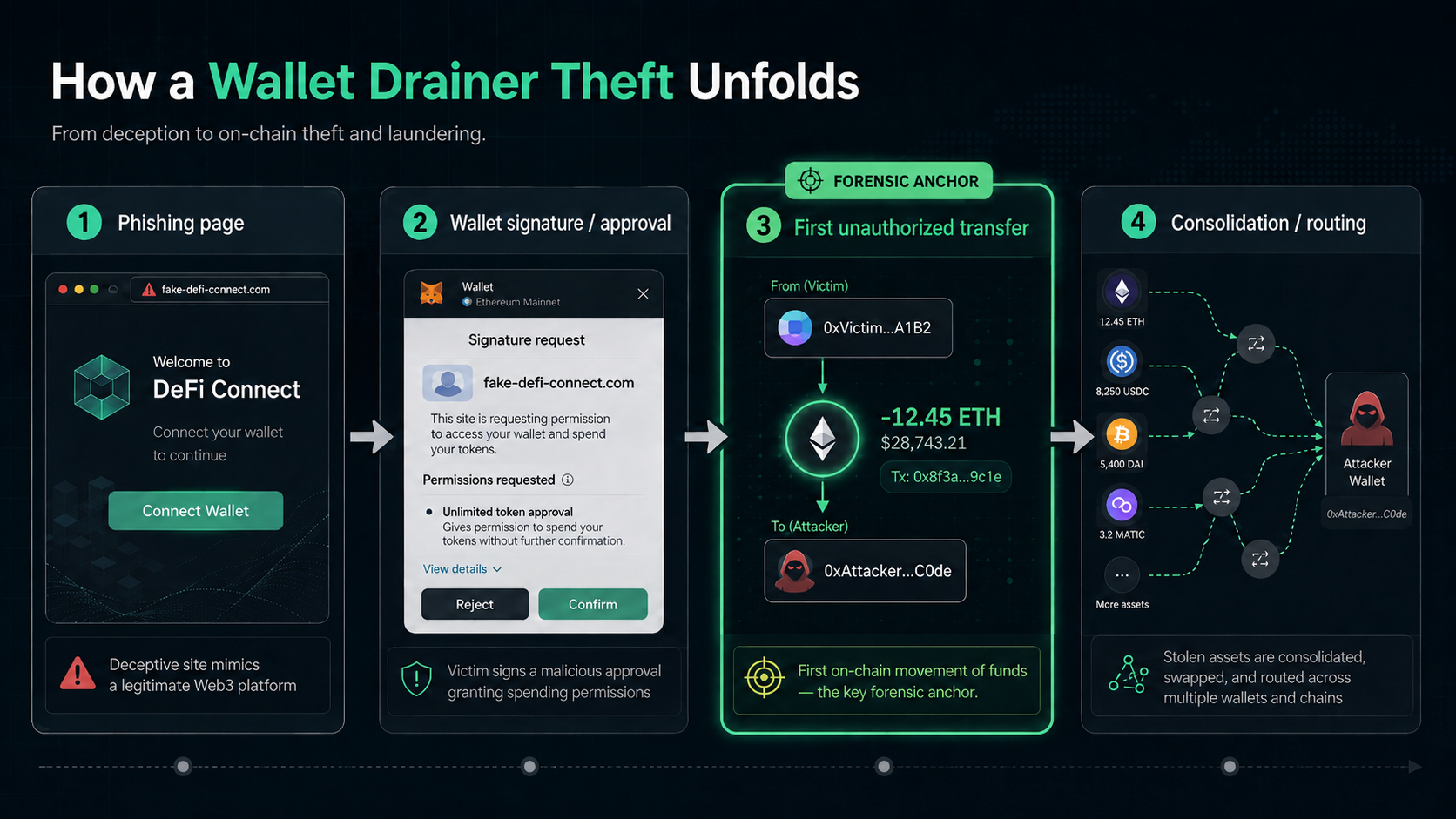
Most drainer incidents begin with social engineering rather than a technical break-in. A fake website, compromised social account, malicious advertisement or direct message leads the user to a page that appears connected with a genuine Web3 project.
The site then prompts the user to connect a wallet and sign a transaction, approval or message. The interface may hide the practical effect behind familiar language such as claim, verify, mint or connect. Once the victim authorizes the action, the drainer can move supported assets or use the permissions granted to it.
MetaMask explains that token approvals can persist beyond the interaction that created them, and malicious approvals can allow a drainer to move tokens later. This is why simply disconnecting a wallet from a site does not necessarily remove the underlying permission.
Some incidents involve several asset types and multiple transactions in rapid succession. That speed is one reason users often notice the problem only after the wallet balance has already changed.
A hardware wallet can reduce some forms of key theft, but it does not automatically protect a user who intentionally approves a malicious transaction on the hardware device. The security decision still depends on what is being signed.
What does a drainer theft look like on-chain?
After a successful drainer event, the blockchain can provide a detailed record of what moved. Investigators may see direct token transfers, NFT transfers, calls to contracts, approval-related activity and subsequent consolidation into attacker-controlled wallets.
The analytical task is to reconstruct the sequence rather than assume that every outgoing transaction has the same cause. A wallet may contain legitimate user activity, malicious approvals and attacker transfers close together in time.
Investigators typically establish the first unauthorized event, identify the stolen assets, follow their subsequent movement and check whether funds reach identifiable services. Cross-chain swaps, bridges and decentralized protocols can increase complexity, but they do not erase the original transaction evidence.
The first unauthorized transaction is usually the anchor for the rest of the investigation. Later movements may be entirely attacker-controlled, so separating the initial victim-authorized action from subsequent consolidation and routing helps explain both how the theft happened and where the assets went.
INVESTIGATOR INSIGHT
“The first unauthorized transaction is usually the anchor. We first establish what the victim actually signed and which asset movement resulted from it, then separate that from the attacker’s later consolidation and routing. In the first hour, the most valuable evidence is the transaction hash, wallet address, exact timestamp, phishing URL or message, and any screenshot of the signing prompt that still exists. That combination helps us reconstruct both the on-chain movement and the mechanism of compromise.”
— Žiga Karič, Blockchain forensic investigator, Bloctopus Intelligence
Can crypto drainer funds be traced or recovered?
In many cases, drainer-stolen assets can be traced because the transfers occur on public blockchains. The trace may show where tokens, NFTs or converted assets moved after leaving the victim wallet.
Recovery is more difficult. If the assets remain in attacker-controlled self-custody, a forensic report cannot force the wallet to return them. A more actionable scenario may arise if the assets reach a centralized exchange or another custodian that can identify an account and cooperate with a lawful freeze, disclosure or seizure process.
Speed matters because stolen assets may be redistributed or converted soon after the theft. Evidence quality also matters. A credible case should connect the victim wallet, unauthorized transaction, subsequent flow and any attributed service without overclaiming what software labels can prove.
For larger incidents, professional crypto funds tracking can help determine whether the path contains a realistic recovery opportunity. Tracing itself should never be presented as a guarantee of recovery.
What should you do immediately after a wallet drainer attack?
The correct first steps depend on the compromise type, but the priorities are containment, evidence and verification.
- Stop interacting with the suspicious site. Close the page and do not sign additional requests intended to supposedly reverse or verify the first transaction.
- Check what moved. Record the unauthorized transaction hashes, assets, destination addresses and timestamps.
- Review permissions using trusted tools. Use the wallet or network's official security and approval-management resources where available. Do not connect the affected wallet to an unknown revocation website.
- Protect unaffected assets. If there is reason to believe the seed phrase or private key is compromised, create a new wallet from a clean environment rather than continuing to use the same keys.
- Preserve the phishing evidence. Save the URL, screenshots, browser history, social media post or message that led to the site, and the exact time of interaction.
- Report significant theft quickly. Notify relevant exchanges, law enforcement or cybercrime reporting channels where appropriate, using a structured evidence package.
Do not send more crypto to anyone who claims they need a gas fee, validation payment or deposit to recover the stolen funds. That is a common path to re-victimization.
Can you revoke a drainer approval after the theft?
Revoking a malicious token approval can be important when the approval still exists and assets remain in the wallet. It can limit the attacker's ability to use that specific permission again.
MetaMask notes that revoking an approval removes that contract’s future permission to move the specified token, but it does not reverse a transfer that has already been confirmed.
It is also important not to reduce every incident to approvals. Some drainers prompt direct transfers, signatures with broader effects or interactions that differ between networks and token standards. The technical response should be based on the actual transactions rather than a generic checklist.
How can you protect against crypto drainers?
The strongest protection is to reduce the chance that a high-value wallet signs an unexpected request. Practical controls include:
- Use bookmarks or independently verified links for protocols you use regularly instead of links received through messages or ads.
- Treat unexpected airdrops, NFT claims and urgent wallet-verification prompts as high risk.
- Read wallet transaction prompts carefully, especially permissions and asset movements.
- Separate long-term holdings from wallets used for routine Web3 interactions.
- Use a low-value interaction wallet when testing unfamiliar decentralized applications.
- Keep browser extensions, wallet software and devices updated, and review connected applications periodically.
These controls do not eliminate risk, but they reduce the impact of a single bad signature.
How do drainer cases differ from a hacked wallet?
A user often says the wallet was hacked whenever assets disappear, but the underlying cause matters. A stolen seed phrase gives an attacker direct key control. A drainer may instead exploit an authorization that the legitimate owner signed. Malware can also intercept credentials or manipulate what the user sees.
The blockchain may reveal what happened to the assets, but device evidence and user interaction history can be necessary to explain how the transaction was authorized. That distinction can affect containment, reporting and the strength of the final forensic narrative.
Bloctopus Intelligence’s incident reporting process is designed to organize transaction evidence and incident context before the information is provided to exchanges, legal counsel or authorities.
What not to do after a drainer theft
Urgency creates a second risk: recovery scams. People who publicly post that their wallet was drained often receive direct messages from supposed hackers, recovery agents or support representatives.
Do not share a seed phrase or private key. Do not install remote-access software at the request of an unknown helper. Do not pay an upfront release, tax or recovery fee to a wallet that contacted you after the incident.
A legitimate investigation should begin with evidence and feasibility, not a guarantee. If someone claims that a transaction can definitely be reversed or that funds are already recovered before examining the case, treat that claim with caution.
A drainer leaves evidence, but evidence is not the same as recovery
Crypto drainers are fast because they exploit wallet authorization at the moment the victim believes they are completing a legitimate Web3 action. Once the transfer is confirmed, the blockchain preserves a record of the theft and subsequent movement.
That record can be valuable. It can establish the stolen assets, identify the first receiving wallets, reveal consolidation patterns and, in some cases, lead to an attributable service.
The realistic path after a serious drainer incident is therefore containment first, forensic reconstruction second and recovery assessment third. The goal is to preserve the evidence and identify an actionable route without promising an outcome the transaction path cannot support.